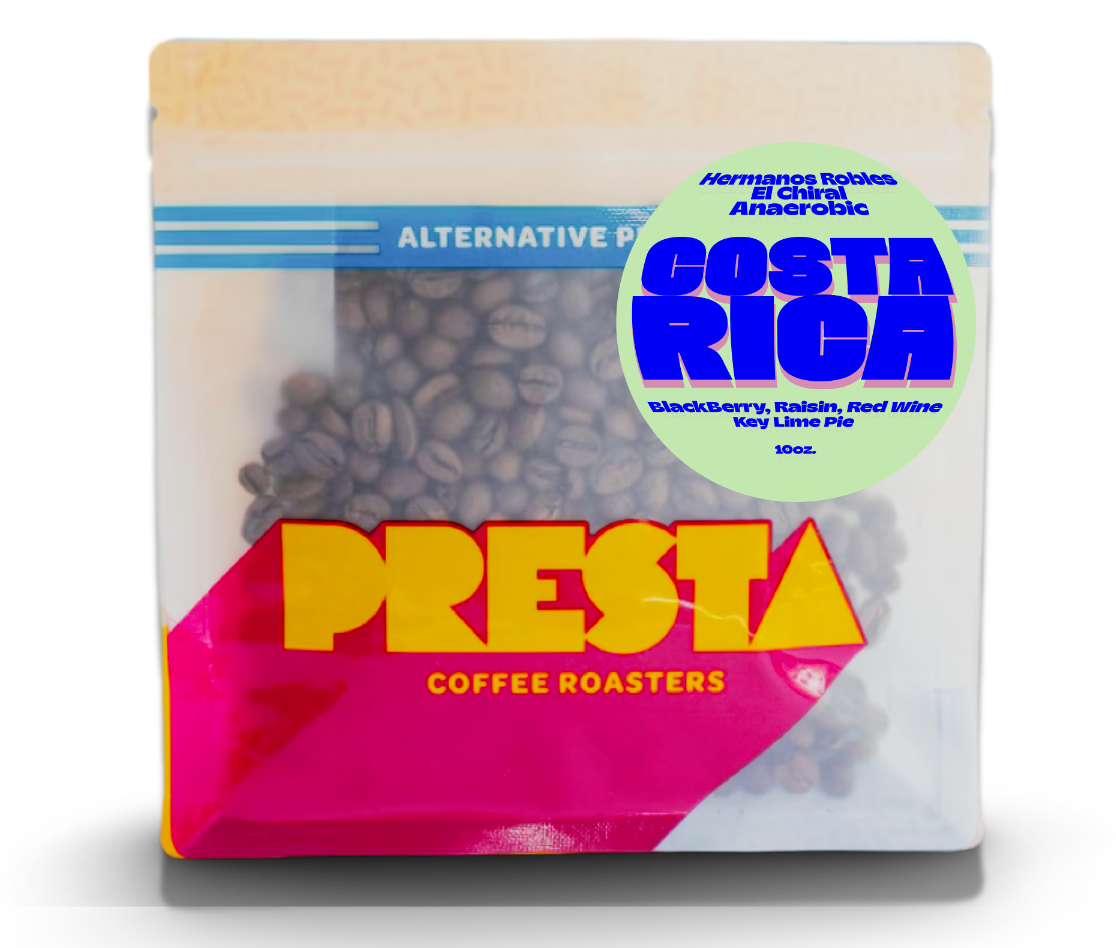
Costa Rica - Hermano Robles- El Chiral Typica- Anaerobic
Costa Rica - Hermano Robles- El Chiral Typica- Anaerobic
Couldn't load pickup availability
Ships directly from Presta Coffee, roasted to order and usually shipped within 48 hours (Mon–Fri). US delivery is typically 2–6 business days. Orders with coffees from more than one roaster arrive as separate boxes. Shipping & freshness →
?
Tasting Notes
Specific flavors and aromas the roaster (or our team) noticed when cupping this coffee. They describe the brewed cup, not flavorings added to the beans.
Read more in the glossary →-
Roast Level
?
Roast Level
How dark the beans are roasted, on a 'specialty' scale where Light/Ultralight preserves the most origin character.
Read more in the glossary → - Specialty Light/Ultralight
-
Flavor Profile
?
Flavor Profile
High-level flavor families this coffee leans toward — fruity, floral, sweet, chocolate/nutty, spicy, tea/botanical, or fermented/wine-like.
Read more in the glossary → - Fruity, Fermented/Wine
-
Origin Type
?
Coffee Type
Whether a coffee is a single origin (from one farm, region, or country) or a blend (multiple origins combined).
Read more in the glossary → - Single Origin
-
Flavor Notes
?
Flavor Notes (SCA)
More specific flavor families inside the broader profile, using the SCA Coffee Taster's Flavor Wheel — e.g. 'Citrus' and 'Berry' inside 'Fruity'.
Read more in the glossary → - Berry, Dried Fruit, Wine, Citrus
-
Caffeine
?
Caffeine
Whether this coffee is caffeinated or decaffeinated, and (for decaf) which process was used.
Read more in the glossary → - Caffeinated
-
Country of Origin
?
Country of Origin
Where in the world this coffee was grown, or 'Multiple' for a blend with beans from more than one country.
Read more in the glossary → - Costa Rica
-
Process Type
?
Processing
How the coffee cherry was prepared after picking — dried with or without its fruit, fermented under specific conditions, etc. Big effect on the final cup.
Read more in the glossary → - Anaerobic
Costa Rica - Hermano Robles- El Chiral Typica- Anaerobic
Elevation: 1800 masl
Region: Los Santos
Subregion: San Marcos
Farm Size: 3 hectares
Variety: Typica
Process: Natural Anaerobic
Tasting Notes: Blackberry, Raisin, Red Wine, Key Lime Pie
Producer Story: RYS is a family-run micro mill and business. It’s owned by the father (Carlos), and two brothers Leo and Elian, who have been working together in their own plantations as well as their father for many years. The micro wet mill is located in El Balar at 1500 masl. They have been processing their own coffee for 13 years now and are some of the pioneers in Tarrazu which started micro wet milling in the early 2000’s.We really value the work that the Robles brothers are doing together. They are very open to experimenting and listening to our feedback. During the first years of operations they were doing mostly honey and natural process for their coffees. Later on, they built a fermentation tank in order to be able to process double washed coffee and to soak the beans for different fermentations. It seems that they believe that the extra work naturals require is worth it, because they can get better prices for naturals, and also because the result in the cup gives them an advantage.
Lot Description - El CerroEl Cerro is the highest point of this particular farm and is at its peak. This means that the farm gets 2 different kinds of exposure depending on both time of day and weather patterns. This is also one of the newest sections of this farm with the youngest and most vigorous plantations. This lot is starting to produce a lot of coffee fruit and the family is very happy with that. The work that goes into this farm along with the way it is done in harmony with the environment truly shows in their qualities.El Balar is a small area just to the west of the most central town of Tarrazu, San Marcos. Its picturesque rolling hills of coffee plantations and excellent micro climate make it a sought after area for high quality fruit. The Robles Family has their plantation there and they have recently renovated the farm which results in young vigorous trees that produce ideal coffee cherries.
This area is also where they live and where their wet mill is located, so the proximity to the farm really helps when it comes to transportation and sound processing of their product. The family ensures sound management of the farm in harmony with the pristine environment. They stay away from herbicides, pesticides, and cutting down shade trees.
Processing - Anaerobic After selecting the ripest cherries, they bring the coffee to the wet mill where they have a floating system that separates the vane beans and floaters from the ripe and good ones. Then they put the coffee inside of fermentation tanks for a couple days. After fermenting the coffee in tanks they put it on concrete patios in large mounds to pre-dry, then they move the cherries to a static mechanical dryer that works with heat at low temperatures and over long periods of time. Typically, this Anaerobic natural process takes around 1 week to dry. It’s important for them to do an even drying and at low temperatures.
Processing - Natural After selecting the ripest cherries, they bring the coffee to the wet mill where they have a floating system that separates the vane beans and floaters from the ripe and good ones. Then they put the coffee out on concrete patios in very large mounds and allow it to ferment, untouched, for 3 or 4 days. After fermenting and a bit of drying on the hot concrete patio, they move the cherries to a static mechanical dryer that works with heat at low temperatures and over long periods of time. Typically, this fermented natural process takes around 1 week to dry. It’s important for them to do an even drying and at low temperatures. They also make it a point to let the naturals rest in closed, secure sacks with the pulp/parchment after the drying period for about a month. They believe that during this time, the coffee can absorb some of the properties and flavors from the parchment that will help add complexity in the cupping.