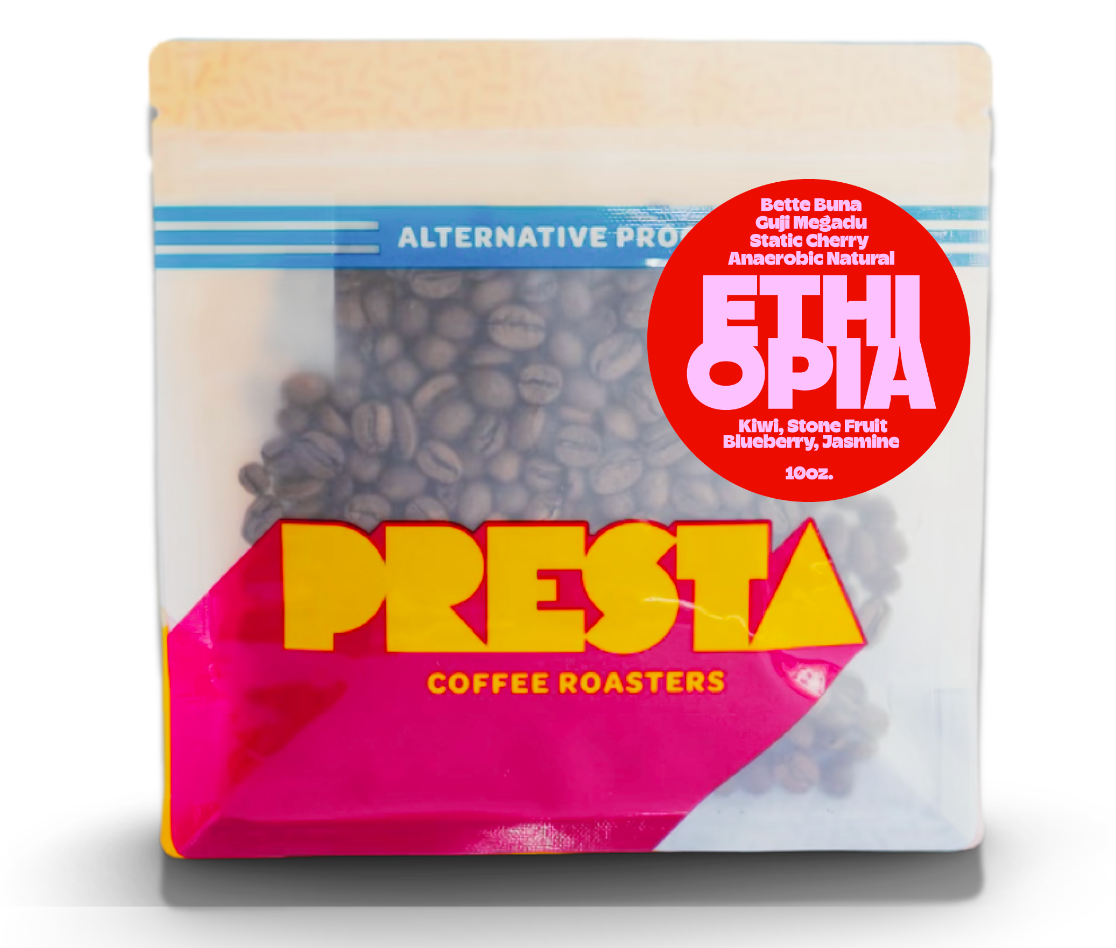
Ethiopia - Bette Buna - Guji Megadu - Static Cherry Anaerobic Natural
Ethiopia - Bette Buna - Guji Megadu - Static Cherry Anaerobic Natural
Couldn't load pickup availability
Ships directly from Presta Coffee, roasted to order and usually shipped within 48 hours (Mon–Fri). US delivery is typically 2–6 business days. Orders with coffees from more than one roaster arrive as separate boxes. Shipping & freshness →
?
Tasting Notes
Specific flavors and aromas the roaster (or our team) noticed when cupping this coffee. They describe the brewed cup, not flavorings added to the beans.
Read more in the glossary →-
Roast Level
?
Roast Level
How dark the beans are roasted, on a 'specialty' scale where Light/Ultralight preserves the most origin character.
Read more in the glossary → - Specialty Light/Ultralight
-
Flavor Profile
?
Flavor Profile
High-level flavor families this coffee leans toward — fruity, floral, sweet, chocolate/nutty, spicy, tea/botanical, or fermented/wine-like.
Read more in the glossary → - Fruity, Floral
-
Origin Type
?
Coffee Type
Whether a coffee is a single origin (from one farm, region, or country) or a blend (multiple origins combined).
Read more in the glossary → - Single Origin
-
Flavor Notes
?
Flavor Notes (SCA)
More specific flavor families inside the broader profile, using the SCA Coffee Taster's Flavor Wheel — e.g. 'Citrus' and 'Berry' inside 'Fruity'.
Read more in the glossary → - Stone Fruit, Floral, Berry, Other Fruit
-
Caffeine
?
Caffeine
Whether this coffee is caffeinated or decaffeinated, and (for decaf) which process was used.
Read more in the glossary → - Caffeinated
-
Country of Origin
?
Country of Origin
Where in the world this coffee was grown, or 'Multiple' for a blend with beans from more than one country.
Read more in the glossary → - Ethiopia
-
Process Type
?
Processing
How the coffee cherry was prepared after picking — dried with or without its fruit, fermented under specific conditions, etc. Big effect on the final cup.
Read more in the glossary → - Anaerobic
Country: EthiopiaRegion: Guji, MegaduFarm: Bette Buna FarmProducer: Hester WesterveldProcess: Static Cherry Anaerobic NaturalVariety: 74158, 74112Elevation: 1,900–2,200 m.a.s.l.Harvest: 2024 - 2025
This lot comes from Bette Buna's own farm in Guji Megadu, where cherries ripen into a brilliant red, making them easy to pick. Despite the ideal conditions, the farm faced labor shortages this season, leaving many ripe cherries unharvested. For their Premiere anaerobic lots, the team uses only freshly picked, perfectly ripe cherries-so while volumes were lower, the quality remained uncompromised.
Bette Buna has worked by training farmers in soil regeneration, agroforestry, and selective harvesting of ripe cherries, while also distributing over 350,000 climate-adapted seedlings annually to increase long-term farmer income. Their commitment to equal opportunity employment includes hiring people with disabilities, single mothers, and other marginalized groups, while maintaining exceptional traceability for every lot they produce.
Process:This lot was processed using Bette Buna’s “Static Cherry” method, developed and refined over the past two years. The cherries were first rested in the sun for a few hours before undergoing controlled anaerobic fermentation. Once fermentation reached the desired parameters, the cherries were spread in thin layers on raised African drying beds, allowing airflow to ensure even drying. This stage took about 20–25 days, depending on climate conditions, until the cherries reached optimal moisture content. The coffee then rested in cherry for a minimum of eight weeks to enhance complexity before hulling. After dry milling to remove the hulls, the beans underwent multiple rounds of hand sorting, screening by size and density, and color sorting at Bette Buna’s dry mill in Gelan, near Addis Ababa, before being prepared for export.
As the coffee industry continues to grow in Ethiopia, the country’s historic growing areas don’t always match up with the current-day maps defining Ethiopia’s geography. Our goal is to provide the clearest and most accurate information about the coffees that we offer, and we’re proud to provide the most specific location information we have for these coffees.
Region:Guji is a zone in the Oromia Region of southern Ethiopia. Most residents of this region are Oromo and speak the Oromo language, which is entirely different from Ethiopia's main language of Amharic. Like many of the country's coffee growing regions, the culture of the Guji Zone varies from woreda to woreda and speaks to the diversity of people who cultivate coffee. More small washing stations are being built in Guji to respond to the demand for improvements in processing to fully capture the range of attributes found in Ethiopian coffee. The Zone's principal fresh water source is the Ganale Dorya river, which also acts as the boundary line with the neighboring Bale zone to the east. To the west, Guji borders the southern Gedeb woreda of the Gedeo Zone in the neighboring Southern Nations, Nationalities, and People's Region, part of the Yirgacheffe coffee growing area.