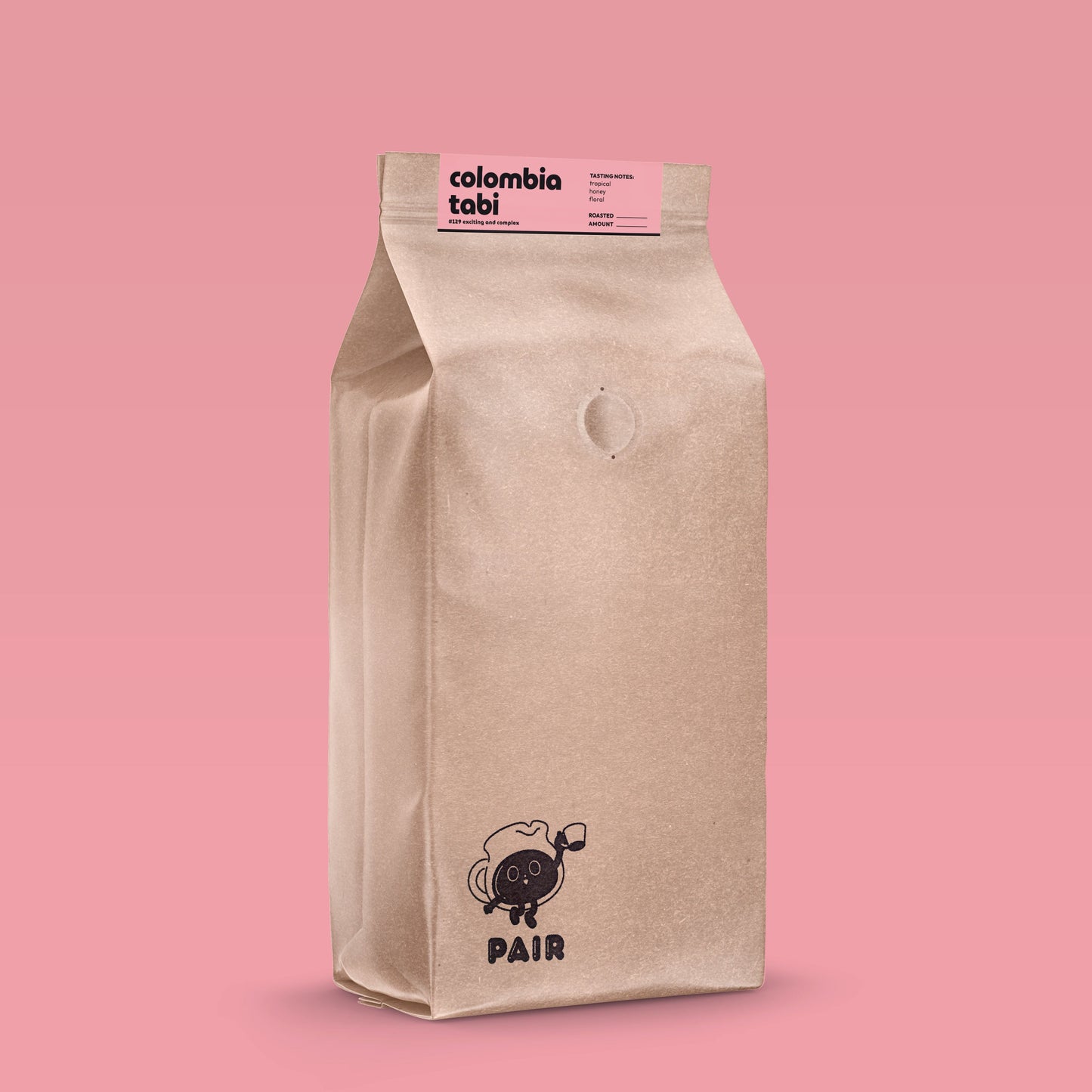
#129 Washed-Processed Tabi Coffee Beans from Colombia
#129 Washed-Processed Tabi Coffee Beans from Colombia
Couldn't load pickup availability
Ships directly from Pair Cupworks, roasted in small batches and usually shipped within 7 business days. US delivery is typically 2–6 business days. Orders with coffees from more than one roaster arrive as separate boxes. Shipping & freshness →
?
Tasting Notes
Specific flavors and aromas the roaster (or our team) noticed when cupping this coffee. They describe the brewed cup, not flavorings added to the beans.
Read more in the glossary →-
Roast Level
?
Roast Level
How dark the beans are roasted, on a 'specialty' scale where Light/Ultralight preserves the most origin character.
Read more in the glossary → - Specialty Light/Ultralight
-
Flavor Profile
?
Flavor Profile
High-level flavor families this coffee leans toward — fruity, floral, sweet, chocolate/nutty, spicy, tea/botanical, or fermented/wine-like.
Read more in the glossary → - Fruity, Floral
-
Origin Type
?
Coffee Type
Whether a coffee is a single origin (from one farm, region, or country) or a blend (multiple origins combined).
Read more in the glossary → - Single Origin
-
Flavor Notes
?
Flavor Notes (SCA)
More specific flavor families inside the broader profile, using the SCA Coffee Taster's Flavor Wheel — e.g. 'Citrus' and 'Berry' inside 'Fruity'.
Read more in the glossary → - Tropical, Floral
-
Caffeine
?
Caffeine
Whether this coffee is caffeinated or decaffeinated, and (for decaf) which process was used.
Read more in the glossary → - Caffeinated
-
Country of Origin
?
Country of Origin
Where in the world this coffee was grown, or 'Multiple' for a blend with beans from more than one country.
Read more in the glossary → - Colombia
-
Process Type
?
Processing
How the coffee cherry was prepared after picking — dried with or without its fruit, fermented under specific conditions, etc. Big effect on the final cup.
Read more in the glossary → - Washed
- Origin: Region Huila, Colombia
- Altitude: 1780 masl
- Grower/Producer: Finca Las Flores, Jhoan Vergara Ayure
- Processing: Washed
- Variety: Tabi
- Harvest Time: October - December
More Coffee Info
Las Flores was founded in 1990 by Edilberto Vergara and Nubia Ayure, originally from Cundinamarca and children of coffee growers who passed on their passion for farming, particularly coffee. The farm covers 16 hectares, of which only 2 were initially planted with coffee. By 1998, the entire property was under cultivation, following the traditional cycle of growing, harvesting, washing, drying, and selling. In 2006, Nubia entered the Cup of Excellence and placed 30th, marking the family’s first step into the world of specialty coffee. Her passing left a legacy and a mission for her five children: to explore coffee more deeply, from its cultivation to its destination in the cup.
Driven by curiosity, her son Jhoan Vergara Ayure—today the farm’s lead cupper, process designer, and commercial representative—studied at SENA to strengthen his technical and practical knowledge in coffee production. This led to the introduction of new varieties and the creation of cup profiles aligned with the farm’s terroir. Jhoan works alongside his brother Diego Vergara, who is in charge of processing, fermentation control, and drying, ensuring that each lot meets the highest quality standards. Together, they have developed replicable processes, including natural, honey, hydro-honey, and washed, that highlight each variety’s potential and have brought Las Flores recognition both nationally and internationally. The farm’s accolades include first place in Colombia’s Top Roast process category in 2022, multiple Top Roast placements in 2021, and first place in the 2019 Master of Coffee competition in South Korea with their Pink Bourbon semi-washed.
Coffees from Las Flores have been featured by champion baristas worldwide, including at the 2023 World Brewers Cup in Athens. This Tabi lot began with the careful handpicking of ripe cherries, followed by a disinfection stage and floating to remove impurities and low-density cherries. The lot underwent a 24- hour submerged fermentation, followed by an additional 24 hours of oxidation in cherry. After this stage, the coffee was depulped and placed in anaerobic fermentation for 48 hours. Drying was carried out using dehumidifying equipment until optimal moisture content was reached.