#142 Washed Process Coffee Beans from Ethiopia
#142 Washed Process Coffee Beans from Ethiopia
Couldn't load pickup availability
Ships directly from Pair Cupworks, roasted in small batches and usually shipped within 7 business days. US delivery is typically 2–6 business days. Orders with coffees from more than one roaster arrive as separate boxes. Shipping & freshness →
?
Tasting Notes
Specific flavors and aromas the roaster (or our team) noticed when cupping this coffee. They describe the brewed cup, not flavorings added to the beans.
Read more in the glossary →-
Roast Level
?
Roast Level
How dark the beans are roasted, on a 'specialty' scale where Light/Ultralight preserves the most origin character.
Read more in the glossary → - Specialty Light/Ultralight
-
Flavor Profile
?
Flavor Profile
High-level flavor families this coffee leans toward — fruity, floral, sweet, chocolate/nutty, spicy, tea/botanical, or fermented/wine-like.
Read more in the glossary → - Fruity, Tea/Botanical
-
Origin Type
?
Coffee Type
Whether a coffee is a single origin (from one farm, region, or country) or a blend (multiple origins combined).
Read more in the glossary → - Single Origin
-
Flavor Notes
?
Flavor Notes (SCA)
More specific flavor families inside the broader profile, using the SCA Coffee Taster's Flavor Wheel — e.g. 'Citrus' and 'Berry' inside 'Fruity'.
Read more in the glossary → - Citrus, Stone Fruit, Herbal
-
Caffeine
?
Caffeine
Whether this coffee is caffeinated or decaffeinated, and (for decaf) which process was used.
Read more in the glossary → - Caffeinated
-
Country of Origin
?
Country of Origin
Where in the world this coffee was grown, or 'Multiple' for a blend with beans from more than one country.
Read more in the glossary → - Ethiopia
-
Process Type
?
Processing
How the coffee cherry was prepared after picking — dried with or without its fruit, fermented under specific conditions, etc. Big effect on the final cup.
Read more in the glossary → - Washed
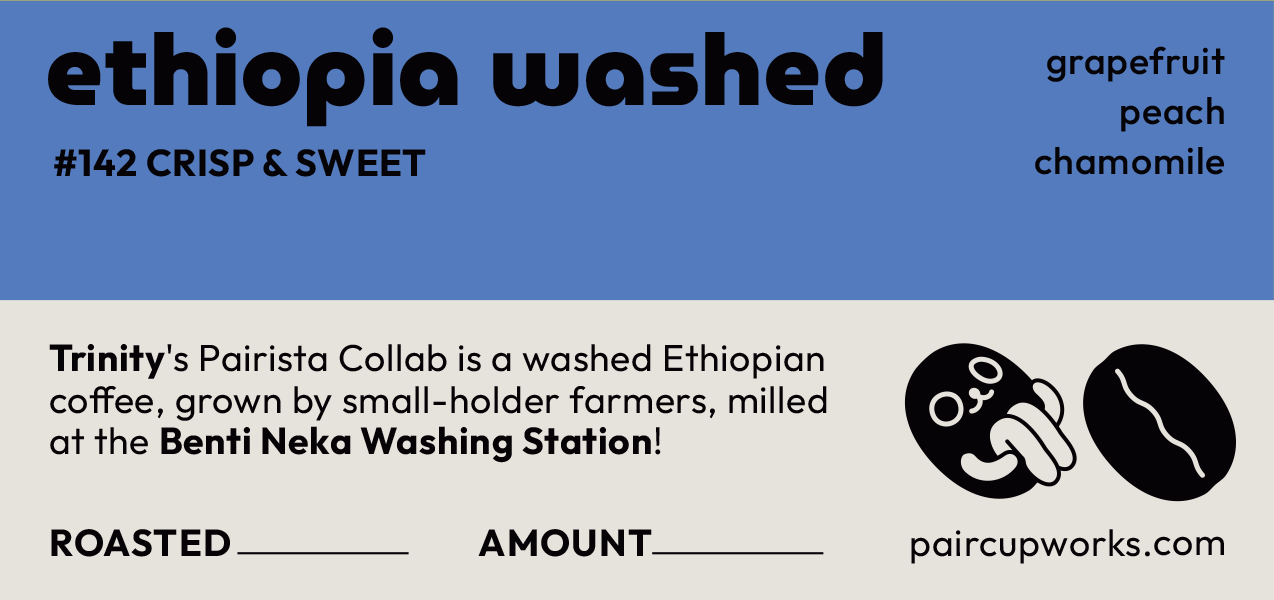
Grapefruit, Peach, Chamomile! -- This coffee is part of our Parista Collabs and was curated by our barista, Trinity! This washed-processed coffee was produced by farmers around Benti Neka Washing Station in Guji, Ethiopia.
Each 8oz retail package comes with a limited-edition sleeve with original art conceptualized by our featured Pair team member and illustrated by our co-owner, Eugenia Tai, along with a bio written by Connor M.! The Pairista Collaboration is our way of celebrating our talented and passionate team members and sharing their values.
- Origin: Benti Neka Kebele, Hambela Wamena, Guji Zone, Oromia
- Elevation: 1900-2200 masl
- Growers/Producers: Benti Neka Washing Station, Azeb Tadesse coffee supplier
- Varietal: Kurmue, Dago, Wolisho
- Processing: Washed
- Harvest Time: November - January
From our Green Coffee Source:
Ethiopian Green Coffee | Benti Neka Washed
This bright Ethiopian green coffee from Benti Neka is rare in being certified organic. While most Ethiopian farmers naturally practice organic farming, few pursue the formal certification process.
Benti Neka, situated in West Guji, is a washing station specializing in washed coffee. Ripe, sorted cherries from farms at elevations of 1,900 to 2,200 masl are pulped in a disc pulper and fermented in cement tanks for 36 to 48 hours to remove mucilage. The pulped coffee is dried for seven to nine days. Once the parchment coffee reaches a moisture content of 10-12%, it is stored in labeled conditioning bins until ready for the dry mill.
Washed processing is widely popular as it allows the terroir of the coffee to shine through. This method highlights the growing conditions, region, and true character of the coffee. At Benti Neka, producers achieve a clean, bright cup profile like this G2 Ethiopian coffee with notes of honey, lemon & lime, and pear, and a tea-like character in its light body.
Traceability is a key focus at Benti Neka, where a voucher system is used to track each coffee lot throughout the production chain. This system ensures that every step, from the receiving station to the drying stage, is documented, tying the coffee back to the farmers who produced it.
Guji Green Coffee Beans
The Oromo people of the Guji region have their own unique origin story for the discovery of coffee, reflecting its deep cultural significance. According to their legend, instead of Kaldi the goatherder, the Oromo sky god Waaqa wept over the wrongful death of a loyal servant, and his tears brought forth a new plant from the earth. Since as early as the 10th century, coffee has been revered in Oromo culture as a special plant, with beans mixed with fats to provide energy on long journeys.
Centuries later, Guji farmers continue to follow traditional growing methods that enhance the region’s fertile soil. Many indigenous coffee varieties still thrive on Ethiopia’s coffee farms. Coffee is typically intercropped with maize, barley, wheat, beans, and other crops that sustain the farmers' families.