Colombia La Muralla
Colombia La Muralla
Couldn't load pickup availability
Ships directly from Mirra Coffee, roasted to order every Wednesday and shipped Thursday (order by Tuesday night NYC time for that week’s roast). US delivery is typically 2–6 business days. Orders with coffees from more than one roaster arrive as separate boxes. Shipping & freshness →
?
Tasting Notes
Specific flavors and aromas the roaster (or our team) noticed when cupping this coffee. They describe the brewed cup, not flavorings added to the beans.
Read more in the glossary →-
Roast Level
?
Roast Level
How dark the beans are roasted, on a 'specialty' scale where Light/Ultralight preserves the most origin character.
Read more in the glossary → - Specialty Light/Ultralight
-
Flavor Profile
?
Flavor Profile
High-level flavor families this coffee leans toward — fruity, floral, sweet, chocolate/nutty, spicy, tea/botanical, or fermented/wine-like.
Read more in the glossary → - Fruity, Spicy, Sweet
-
Origin Type
?
Coffee Type
Whether a coffee is a single origin (from one farm, region, or country) or a blend (multiple origins combined).
Read more in the glossary → - Single Origin
-
Flavor Notes
?
Flavor Notes (SCA)
More specific flavor families inside the broader profile, using the SCA Coffee Taster's Flavor Wheel — e.g. 'Citrus' and 'Berry' inside 'Fruity'.
Read more in the glossary → - Berry, Brown Spice, Caramel
-
Caffeine
?
Caffeine
Whether this coffee is caffeinated or decaffeinated, and (for decaf) which process was used.
Read more in the glossary → - Caffeinated
-
Country of Origin
?
Country of Origin
Where in the world this coffee was grown, or 'Multiple' for a blend with beans from more than one country.
Read more in the glossary → - Colombia
-
Process Type
?
Processing
How the coffee cherry was prepared after picking — dried with or without its fruit, fermented under specific conditions, etc. Big effect on the final cup.
Read more in the glossary → - Washed
Cost per 250mL serving - $1.25
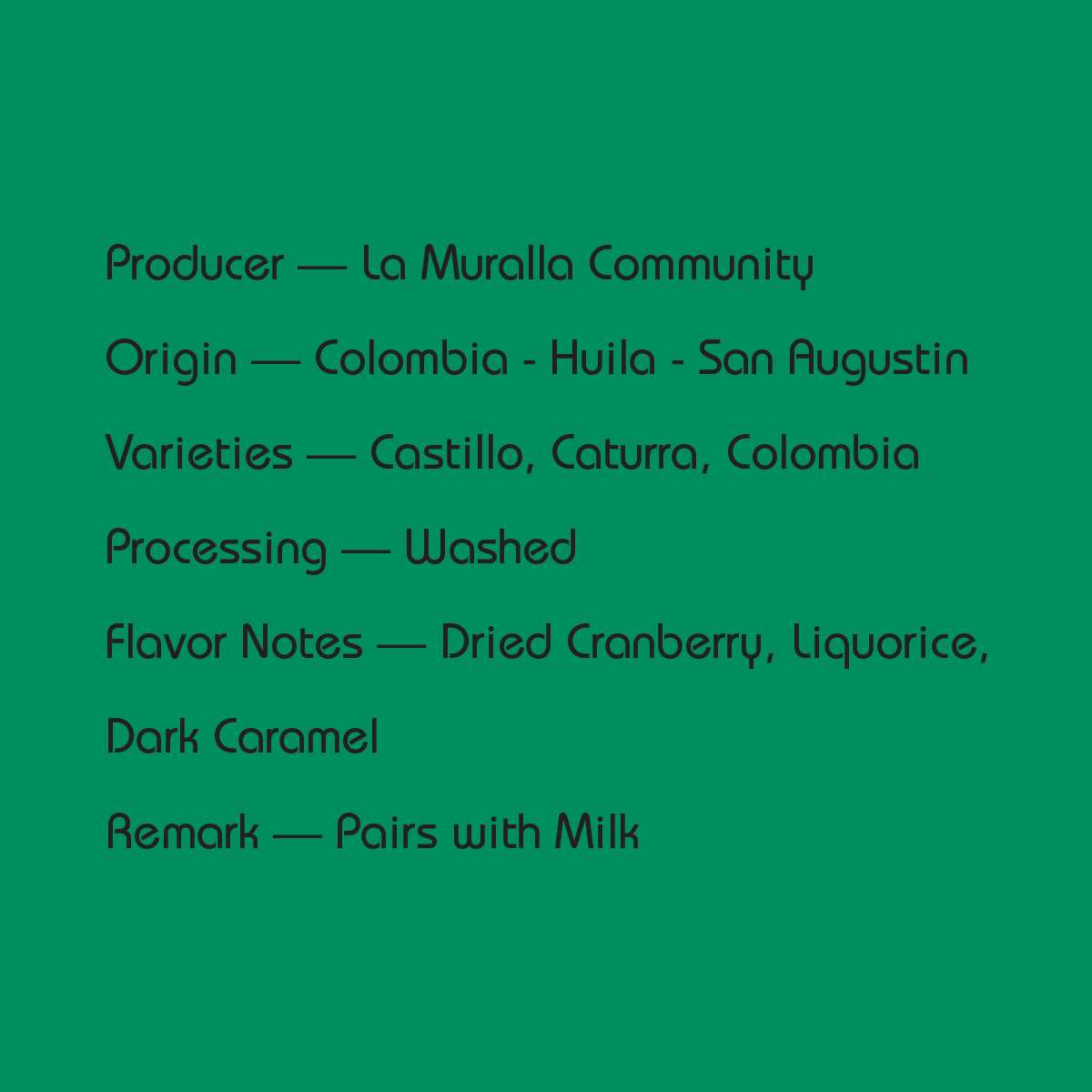
This sweet, round, comforting lot from the La Muralla community of the San Augustin department of Huila, Colombia is our next iteration of our line of white coffees, and as per expectations, it comes through yummy both when doctored with milk, and taken simply black. In this lot, we find pleasant, mild red fruits, reminding us of dried cranberry, as well as a note of sweet black liquorice, and a more thick, robust dark caramel flavor which pleasantly lingers on the finish.
This lot is a hyper-local blend of cherries picked by a collection of producers, all from the La Muralla community of the San Augustin department—one of the southernmost departments in the state of Huila. The average age of the farmers that contributed to this lot is between 20-25, making this a representation of the potential and promise that the next generation of coffee producers in Colombia have in store.
Castillo, like colombia, is a cross between caturra and timor hybrid, also developed by Cenicafe. It was first released in 2005 in response to the persistence of coffee leaf rust. Where caturra was once the most common variety in Colombia, now castillo has taken its place, making up over 40% of all coffee grown there. Named for researcher Jamie Castillo, castillo does better than most varieties when planted in higher density due to the tree’s dwarfism, and as such has a relatively higher yield. Although its quality can range, castillo is able to yield beautiful final cups under careful cultivation, at altitude. In fact in a blind cupping alongside one of Colombia’s most lauded varieties, caturra, there was no notable difference in quality between the two varieties according to professional tasters.
Caturra is a natural mutation of the bourbon variety, and was first discovered in the Minas Gerais region of Brazil between 1915 and 1918. It is common throughout South and Central America, and is known for its flavor quality at altitude.
The colombia variety was developed by researchers at the Cenicafe laboratory in Colombia by crossing caturra and timor hybrid, and was first released for cultivation in 1982. It was bred in anticipation of future outbreaks of leaf rust in Colombia, and is relatively resistant as a consequence. Many credit this variety for saving the Colombian coffee industry following the arrival of leaf rust in the mid-1980’s. Although its quality can range, colombia is able to yield beautiful final cups under careful cultivation, at altitude.
All coffee is sold whole-bean to reduce oxidation, and increase the longevity of volatile organic compounds.