Colombia Paola Trujillo - Sidra
Colombia Paola Trujillo - Sidra
Couldn't load pickup availability
Ships directly from Mirra Coffee, roasted to order every Wednesday and shipped Thursday (order by Tuesday night NYC time for that week’s roast). US delivery is typically 2–6 business days. Orders with coffees from more than one roaster arrive as separate boxes. Shipping & freshness →
?
Tasting Notes
Specific flavors and aromas the roaster (or our team) noticed when cupping this coffee. They describe the brewed cup, not flavorings added to the beans.
Read more in the glossary →-
Roast Level
?
Roast Level
How dark the beans are roasted, on a 'specialty' scale where Light/Ultralight preserves the most origin character.
Read more in the glossary → - Specialty Light/Ultralight
-
Flavor Profile
?
Flavor Profile
High-level flavor families this coffee leans toward — fruity, floral, sweet, chocolate/nutty, spicy, tea/botanical, or fermented/wine-like.
Read more in the glossary → - Fruity, Floral, Tea/Botanical
-
Origin Type
?
Coffee Type
Whether a coffee is a single origin (from one farm, region, or country) or a blend (multiple origins combined).
Read more in the glossary → - Single Origin
-
Flavor Notes
?
Flavor Notes (SCA)
More specific flavor families inside the broader profile, using the SCA Coffee Taster's Flavor Wheel — e.g. 'Citrus' and 'Berry' inside 'Fruity'.
Read more in the glossary → - Tropical, Floral, Tea
-
Caffeine
?
Caffeine
Whether this coffee is caffeinated or decaffeinated, and (for decaf) which process was used.
Read more in the glossary → - Caffeinated
-
Country of Origin
?
Country of Origin
Where in the world this coffee was grown, or 'Multiple' for a blend with beans from more than one country.
Read more in the glossary → - Colombia
-
Process Type
?
Processing
How the coffee cherry was prepared after picking — dried with or without its fruit, fermented under specific conditions, etc. Big effect on the final cup.
Read more in the glossary → - Washed
Cost per 250mL serving - $2.37
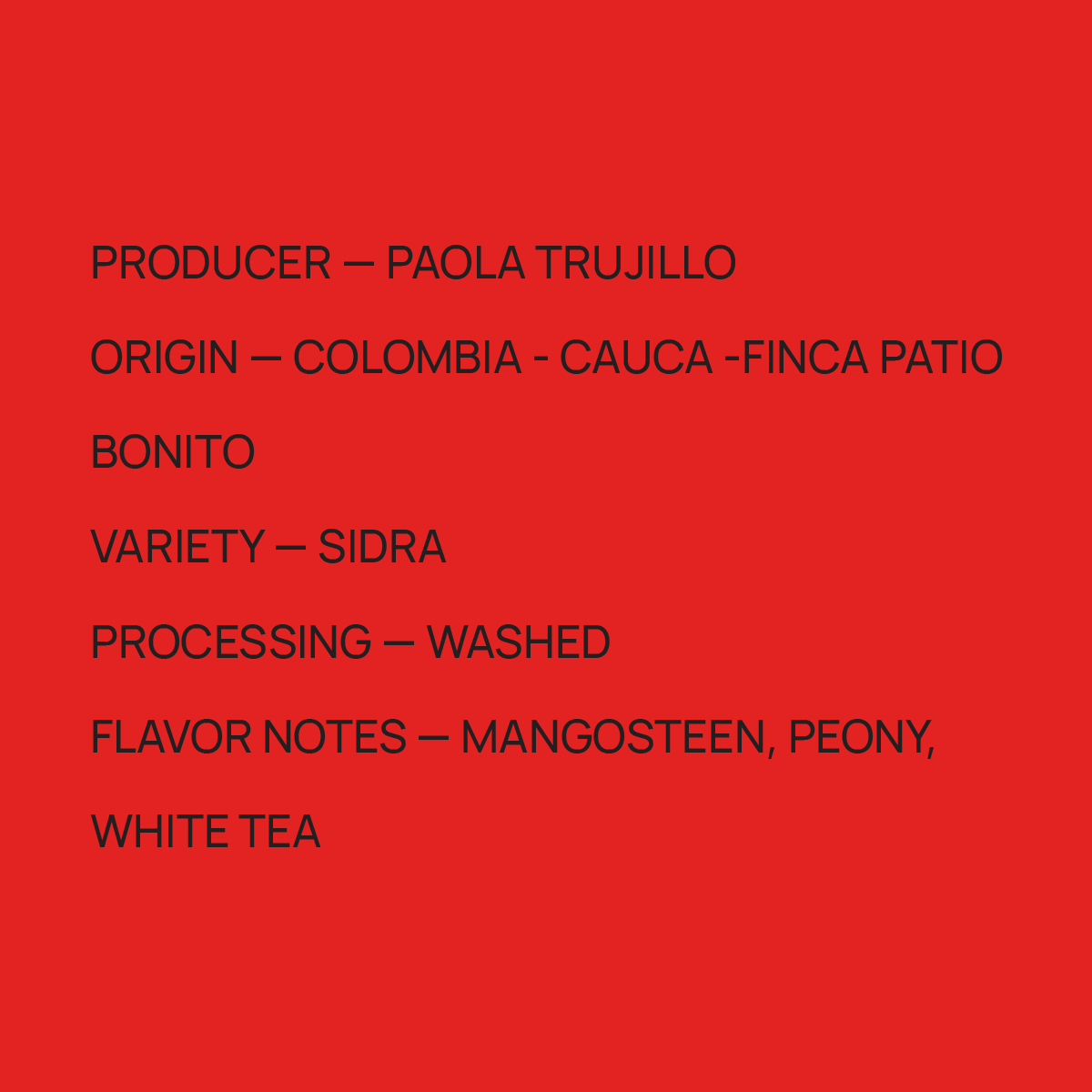
We’re back at it with yet another of Paola’s stunning washed coffees, this one being her sidra; the difference between every lot that we have gotten from her is truly remarkable, from SL28 to pink bourbon to wush wush, each truly stands on its own. For each, the terroir remains the exact same, as does the process, meaning the difference you taste in the cup is 100% variety—something we find invigorating to be sure. This one’s bursting with mangosteen juice and sweetness, the florality of blooming peony, and the delicate tannins and clarity of Chinese white tea.
Paola’s family farm, Patio Bonito, located at 1.700 masl in the coastal region of Cauca, Colombia, has been in the Trujillo family for two generations. It was founded by her father, Carlos Trujillo, who has begin ceding increasing authority over the farm over to his daughters, Paola and Patricia, who have been learning the art of coffee cultivation garnered from Carlos’ 40+ years of experience as a coffee farmer and agroforestry engineer. Patio Bonito is comprised of 9 hectares, planted with over 45.000 coffee trees of varying varietals, such as castillo, typica, colombia, pink bourbon, sidra, wush wush, SL28, geisha, and aji.
The genetic heritage of the sidra variety remains relatively uncertain, with two dominant narratives about its origin. The first theory is that it originated from a Nestle research facility in the Pichincha region of Ecuador, where it was created by crossbreeding typica with bourbon; the second being that it is a naturally-occurring mutation of an Ethiopian landrace variety. Due to demonstrable genetic similarities with native Ethiopian varieties when tested in a lab, as well as similarity in cup profile in terms of sweetness, florality, and stone fruit qualities, the later theory is the one we endorse, making it most likely not actually bourbon at all, and instead yet another example of an Ethiopian landrace variety that made its way to Colombia, just like chiroso, geisha, mejorada, papayo, pink bourbon, aji and wush wush. At present, sidra is primarily grown in Colombia and Ecuador, and has only been commercially farmed since 2012, when La Palma y El Tucan planted 1.800 sidra trees on their farm in Cundinamarca, Colombia.
All coffee is sold whole-bean to reduce oxidation, and increase the longevity of volatile organic compounds.