Costa Rica Felipe & Gerardo Barrantes
Costa Rica Felipe & Gerardo Barrantes
Couldn't load pickup availability
Ships directly from Mirra Coffee, roasted to order every Wednesday and shipped Thursday (order by Tuesday night NYC time for that week’s roast). US delivery is typically 2–6 business days. Orders with coffees from more than one roaster arrive as separate boxes. Shipping & freshness →
?
Tasting Notes
Specific flavors and aromas the roaster (or our team) noticed when cupping this coffee. They describe the brewed cup, not flavorings added to the beans.
Read more in the glossary →-
Roast Level
?
Roast Level
How dark the beans are roasted, on a 'specialty' scale where Light/Ultralight preserves the most origin character.
Read more in the glossary → - Specialty Light/Ultralight
-
Flavor Profile
?
Flavor Profile
High-level flavor families this coffee leans toward — fruity, floral, sweet, chocolate/nutty, spicy, tea/botanical, or fermented/wine-like.
Read more in the glossary → - Fruity, Floral
-
Origin Type
?
Coffee Type
Whether a coffee is a single origin (from one farm, region, or country) or a blend (multiple origins combined).
Read more in the glossary → - Single Origin
-
Flavor Notes
?
Flavor Notes (SCA)
More specific flavor families inside the broader profile, using the SCA Coffee Taster's Flavor Wheel — e.g. 'Citrus' and 'Berry' inside 'Fruity'.
Read more in the glossary → - Berry, Floral
-
Caffeine
?
Caffeine
Whether this coffee is caffeinated or decaffeinated, and (for decaf) which process was used.
Read more in the glossary → - Caffeinated
-
Country of Origin
?
Country of Origin
Where in the world this coffee was grown, or 'Multiple' for a blend with beans from more than one country.
Read more in the glossary → - Costa Rica
-
Process Type
?
Processing
How the coffee cherry was prepared after picking — dried with or without its fruit, fermented under specific conditions, etc. Big effect on the final cup.
Read more in the glossary → - Washed
Cost per 250mL serving - $3.43
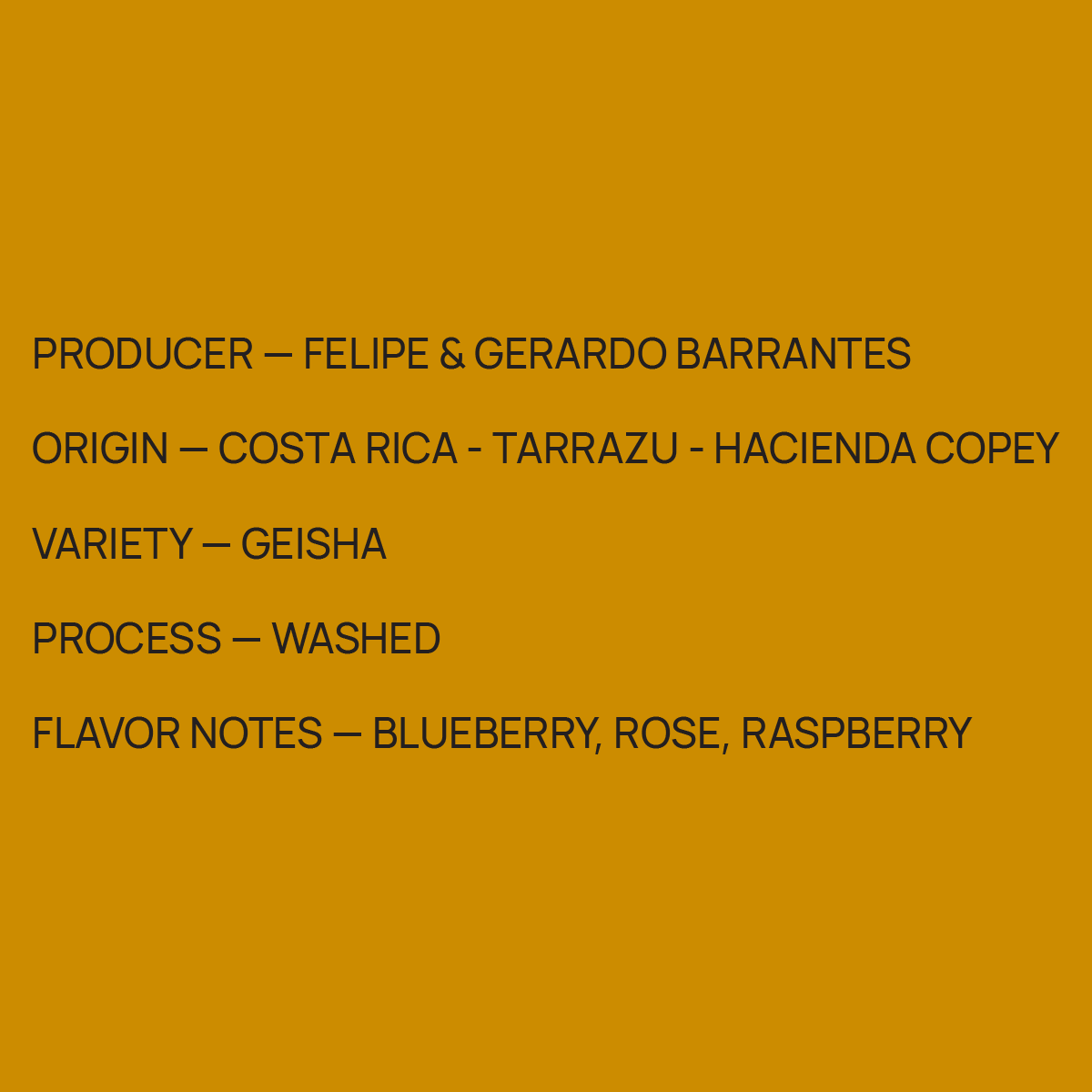
This lovely washed geisha from Felipe and Gerardo Barrantes has been a long time coming; we’ve been actively looking for lots to collaborate with Hacienda Copey on for a couple of years now, and couldn’t be more pleased, finally, to be releasing what we hope will be the first of many collaborative lots with them. In this one, we find all of the complexity, clarity, delicacy, and florals that you can expect from the best Panamanian estates, but with a bit more brightness and backbone—the result of its Costa Rican terroir. This yields a cup replete with tea-like blueberry, perfumey and aromatic rose, and sweet, soft raspberry; suffice it to say, one of the very best geishas we’ve had recently, and one we’re so glad to have brought back from our project in Costa Rica.
Hacienda Copey, located at 2.200 meters in the Tarrazu region of Costa Rica, is a relatively new farm, being founded in 2011 by father and son Felipe and Gerardo Barrantes. Given the high altitude of the farm, it experiences plenty of warmth and sun during the daytime, and much cooler nights, which creates just the kind of day to night temperature variation which is most conducive to the production of extremely sweet and complex coffees. The dark and rich volcanic soil which makes up the farm yields a bright and beautiful representation of terroir in the cup of Copey’s lots.
Geisha is one of the most prized varieties of coffee due to its absolutely exceptional potential for quality, and particularly intense, even perfumed florality, sweetness, and clarity of flavor. Geisha is an Ethiopian heirloom variety, having been first identified in the 1930s in the forests of Gori Gesha. The variety first attracted global attention in 2005, when the Peterson family of Hacienda La Esmeralda in Boquete, Panama entered a lot of geisha grown on their estate into the Best of Panama competition, and won. Ever since, geisha has come to enjoy the status of the most lauded variety of coffee in commercial cultivation, and is heavily represented among winning lots in Cup of Excellence competitions annually.
All coffee is sold whole-bean to reduce oxidation, and increase the longevity of volatile organic compounds.