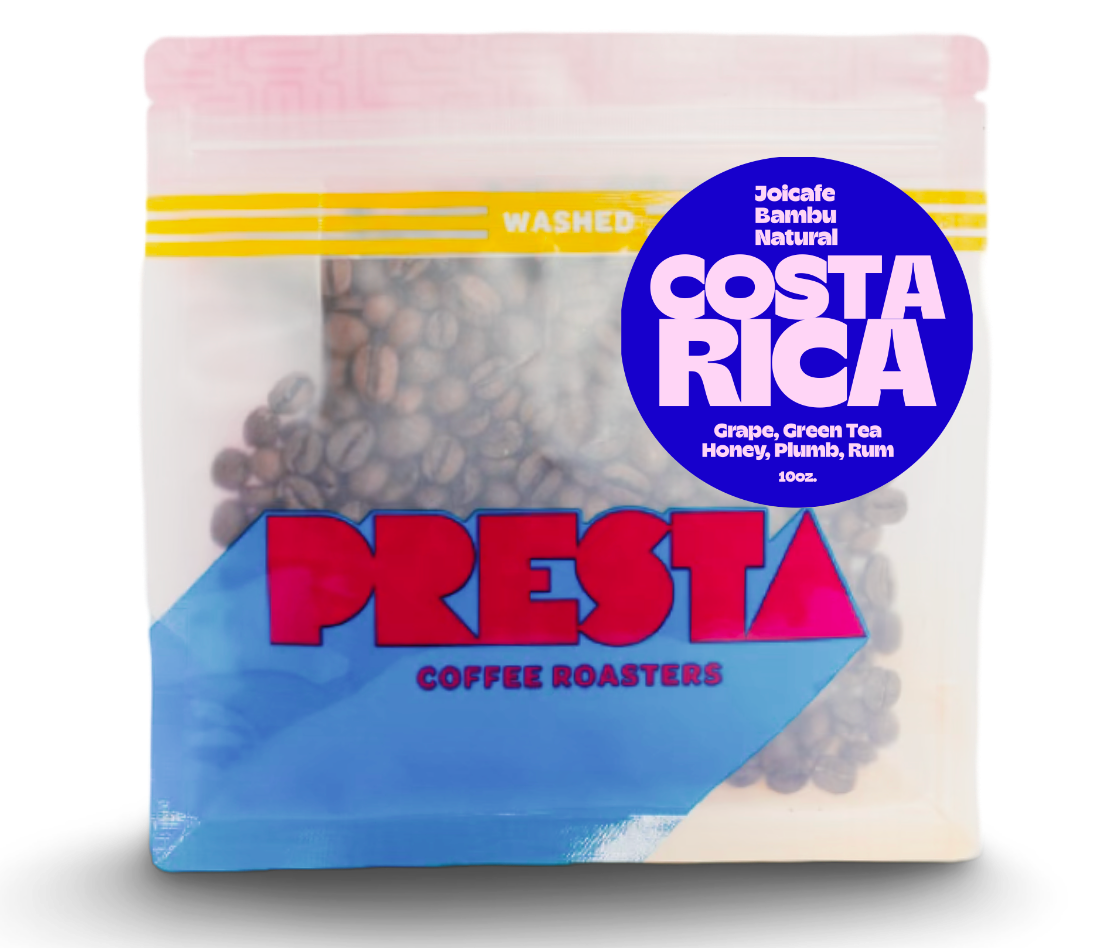
Costa Rica - Joicafe - Bambu Natural
Costa Rica - Joicafe - Bambu Natural
Couldn't load pickup availability
Ships directly from Presta Coffee, roasted to order and usually shipped within 48 hours (Mon–Fri). US delivery is typically 2–6 business days. Orders with coffees from more than one roaster arrive as separate boxes. Shipping & freshness →
?
Tasting Notes
Specific flavors and aromas the roaster (or our team) noticed when cupping this coffee. They describe the brewed cup, not flavorings added to the beans.
Read more in the glossary →-
Roast Level
?
Roast Level
How dark the beans are roasted, on a 'specialty' scale where Light/Ultralight preserves the most origin character.
Read more in the glossary → - Specialty Light/Ultralight
-
Flavor Profile
?
Flavor Profile
High-level flavor families this coffee leans toward — fruity, floral, sweet, chocolate/nutty, spicy, tea/botanical, or fermented/wine-like.
Read more in the glossary → - Fruity, Sweet, Fermented/Wine
-
Origin Type
?
Coffee Type
Whether a coffee is a single origin (from one farm, region, or country) or a blend (multiple origins combined).
Read more in the glossary → - Single Origin
-
Flavor Notes
?
Flavor Notes (SCA)
More specific flavor families inside the broader profile, using the SCA Coffee Taster's Flavor Wheel — e.g. 'Citrus' and 'Berry' inside 'Fruity'.
Read more in the glossary → - Other Fruit, Stone Fruit, Honey, Whiskey
-
Caffeine
?
Caffeine
Whether this coffee is caffeinated or decaffeinated, and (for decaf) which process was used.
Read more in the glossary → - Caffeinated
-
Country of Origin
?
Country of Origin
Where in the world this coffee was grown, or 'Multiple' for a blend with beans from more than one country.
Read more in the glossary → - Costa Rica
-
Process Type
?
Processing
How the coffee cherry was prepared after picking — dried with or without its fruit, fermented under specific conditions, etc. Big effect on the final cup.
Read more in the glossary → - Natural
Process: Natural
Elevation: 1800 masl
Wet mill: Joicafe
Region: Brunca
Sub-Region: Chirripo
Farm Size: 5 hectares
Variety: Catuai
Tasting Notes: Grape, Plum, Honey, Rum
Producer Story
Joicafe is run by Wendy Alvarado and her two sisters. The work they do at their wet mill is so impressive that they have slowly, but surely, made quite a reputation for themselves as some of the best processors and producers to come out of their little, remote town in the southern region of Costa Rica. They have definitely brought pride to their family as is easily seen when their parents speak about the excellent work which they are doing. Their family has always been farmers, but not necessarily with coffee as this area was mainly known for grazing cattle and growing tomatoes. In fact, coffee was never seen as a great option as an agricultural product in their area as the Brunca Growing Region had a bad reputation for quality and therefore coffees from their town would fetch unsustainable prices. However, since this particular town at the base of Costa Rica’s tallest peak, Chirripo, named “Vista de Rivas” has the highest elevations and very fertile soils - the Alvarado Family had the vision and took the risk of starting to grow specialty coffee.
Lot Description
BAMBU - is one of the first farms where The Alvarado Family decided to plant coffee and they chose to use the widely trusted Catuai variety. It is named Bambu because there is a small part of the farm overrun by Bambu Shoots along a creek which runs along the land. The elevation, fertile soil, ideal climate, and careful management of the young farm has led to excellent results when going to process and prepare micro lot caliber coffees.
Processing
NATURAL - They collect the ripest cherries, Joiner tells us that for Naturals it is particularly important to select only ripe fruit. After he measures the coffee his pickers pick they bring them to the wet mill and here they pass it through a floating system where they clean and disinfect the fruit by removing strange materials and vane/unripe fruit. They let the clean cherries rest for 50 hours in mountains, then they spread out the cherries in a thinner layer and sundry them on patios covered by a greenhouse to protect the coffee from rain for 20-25 days depending on the weather.
Dry Milling
This family is quite lucky as their close relatives, also great producers, have built their own dry milling capabilities. It is right next door to them where the coffee is peeled from it’s parchment, sorted by screen size, sorted by density, and finally sorted for defects in an electronic color sorter.