Ethiopia Atiklit Dejene & Eliyas Dukamo - White Honey
Ethiopia Atiklit Dejene & Eliyas Dukamo - White Honey
Couldn't load pickup availability
Ships directly from Mirra Coffee, roasted to order every Wednesday and shipped Thursday (order by Tuesday night NYC time for that week’s roast). US delivery is typically 2–6 business days. Orders with coffees from more than one roaster arrive as separate boxes. Shipping & freshness →
?
Tasting Notes
Specific flavors and aromas the roaster (or our team) noticed when cupping this coffee. They describe the brewed cup, not flavorings added to the beans.
Read more in the glossary →-
Roast Level
?
Roast Level
How dark the beans are roasted, on a 'specialty' scale where Light/Ultralight preserves the most origin character.
Read more in the glossary → - Specialty Light/Ultralight
-
Flavor Profile
?
Flavor Profile
High-level flavor families this coffee leans toward — fruity, floral, sweet, chocolate/nutty, spicy, tea/botanical, or fermented/wine-like.
Read more in the glossary → - Fruity
-
Origin Type
?
Coffee Type
Whether a coffee is a single origin (from one farm, region, or country) or a blend (multiple origins combined).
Read more in the glossary → - Single Origin
-
Flavor Notes
?
Flavor Notes (SCA)
More specific flavor families inside the broader profile, using the SCA Coffee Taster's Flavor Wheel — e.g. 'Citrus' and 'Berry' inside 'Fruity'.
Read more in the glossary → - Berry, Stone Fruit
-
Caffeine
?
Caffeine
Whether this coffee is caffeinated or decaffeinated, and (for decaf) which process was used.
Read more in the glossary → - Caffeinated
-
Country of Origin
?
Country of Origin
Where in the world this coffee was grown, or 'Multiple' for a blend with beans from more than one country.
Read more in the glossary → - Ethiopia
-
Process Type
?
Processing
How the coffee cherry was prepared after picking — dried with or without its fruit, fermented under specific conditions, etc. Big effect on the final cup.
Read more in the glossary → - Honey
Cost per 250mL serving - $1.5
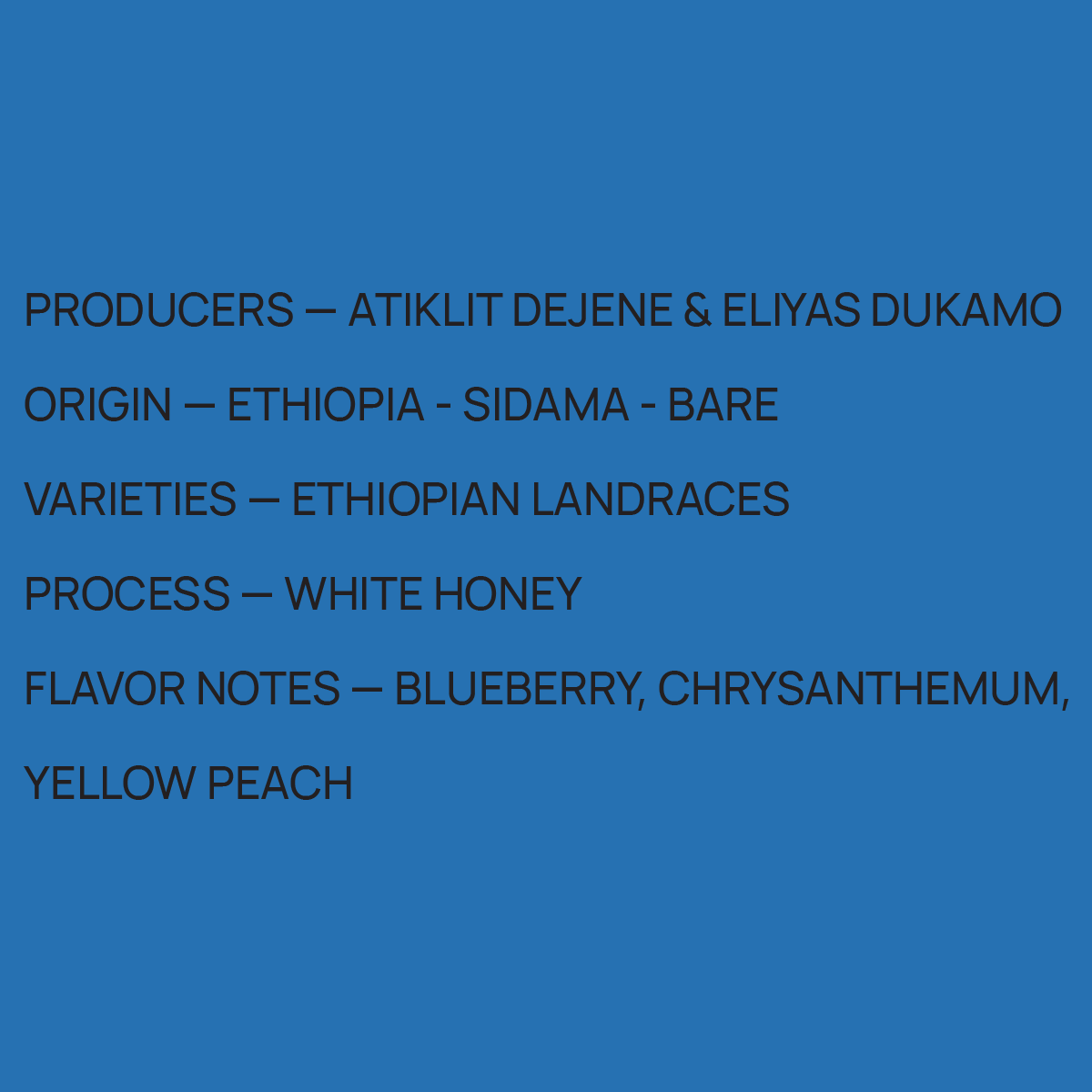
This white honey processing of Atiklit Dejene & Eliyas Dukamo’s lot, from Bare wash station in Sidama, is one that we have been awaiting impatiently, and which we will be releasing alongside its companion: the same lot, but done in a black honey process. We get reams of fresh, wild blueberries in the cup, alongside orange chrysanthemum florals and ripe yellow peach — such a yummy, refreshing coffee.
Atiklit and Eliyas, who are smallholder producers in Sidama, processed this lot at the Bare wash station in Sidama—our favorite region in Ethiopia recently—which is managed by the Tulu family, who has been managing the station across three generations. The station is advised by Aron Fesaha, a skilled and seasoned expert at coffee processing.
Ethiopian landrace or heirloom refers to any variety that is native to Ethiopia. Due to the coffee plant having originated in Ethiopia, and the long duration of its organic evolution and differentiation there, there is far more biodiversity in the genetics of Ethiopian coffee than in the coffee of any other producing country. This rich genetic heritage allows for a very high degree of quality and profile distinction in Ethiopian coffees, resulting in unparalleled complexity and sweetness. Additionally, due to this diversity and a general lack of research into the genetics of Ethiopian landraces, although a few varieties have been identified and named, most remain unnamed. The genetic landscape is so rich that it is often said that every town within the coffee growing regions of Ethiopia has its own distinct variety.
All coffee is sold whole-bean to reduce oxidation, and increase the longevity of volatile organic compounds.