Ethiopia Demeka Becha
Ethiopia Demeka Becha
Couldn't load pickup availability
Ships directly from Mirra Coffee, roasted to order every Wednesday and shipped Thursday (order by Tuesday night NYC time for that week’s roast). US delivery is typically 2–6 business days. Orders with coffees from more than one roaster arrive as separate boxes. Shipping & freshness →
?
Tasting Notes
Specific flavors and aromas the roaster (or our team) noticed when cupping this coffee. They describe the brewed cup, not flavorings added to the beans.
Read more in the glossary →-
Roast Level
?
Roast Level
How dark the beans are roasted, on a 'specialty' scale where Light/Ultralight preserves the most origin character.
Read more in the glossary → - Specialty Light/Ultralight
-
Flavor Profile
?
Flavor Profile
High-level flavor families this coffee leans toward — fruity, floral, sweet, chocolate/nutty, spicy, tea/botanical, or fermented/wine-like.
Read more in the glossary → - Fruity, Floral
-
Origin Type
?
Coffee Type
Whether a coffee is a single origin (from one farm, region, or country) or a blend (multiple origins combined).
Read more in the glossary → - Single Origin
-
Flavor Notes
?
Flavor Notes (SCA)
More specific flavor families inside the broader profile, using the SCA Coffee Taster's Flavor Wheel — e.g. 'Citrus' and 'Berry' inside 'Fruity'.
Read more in the glossary → - Stone Fruit, Floral, Berry
-
Caffeine
?
Caffeine
Whether this coffee is caffeinated or decaffeinated, and (for decaf) which process was used.
Read more in the glossary → - Caffeinated
-
Country of Origin
?
Country of Origin
Where in the world this coffee was grown, or 'Multiple' for a blend with beans from more than one country.
Read more in the glossary → - Ethiopia
-
Process Type
?
Processing
How the coffee cherry was prepared after picking — dried with or without its fruit, fermented under specific conditions, etc. Big effect on the final cup.
Read more in the glossary → - Honey
Cost per 250mL serving - $1.50
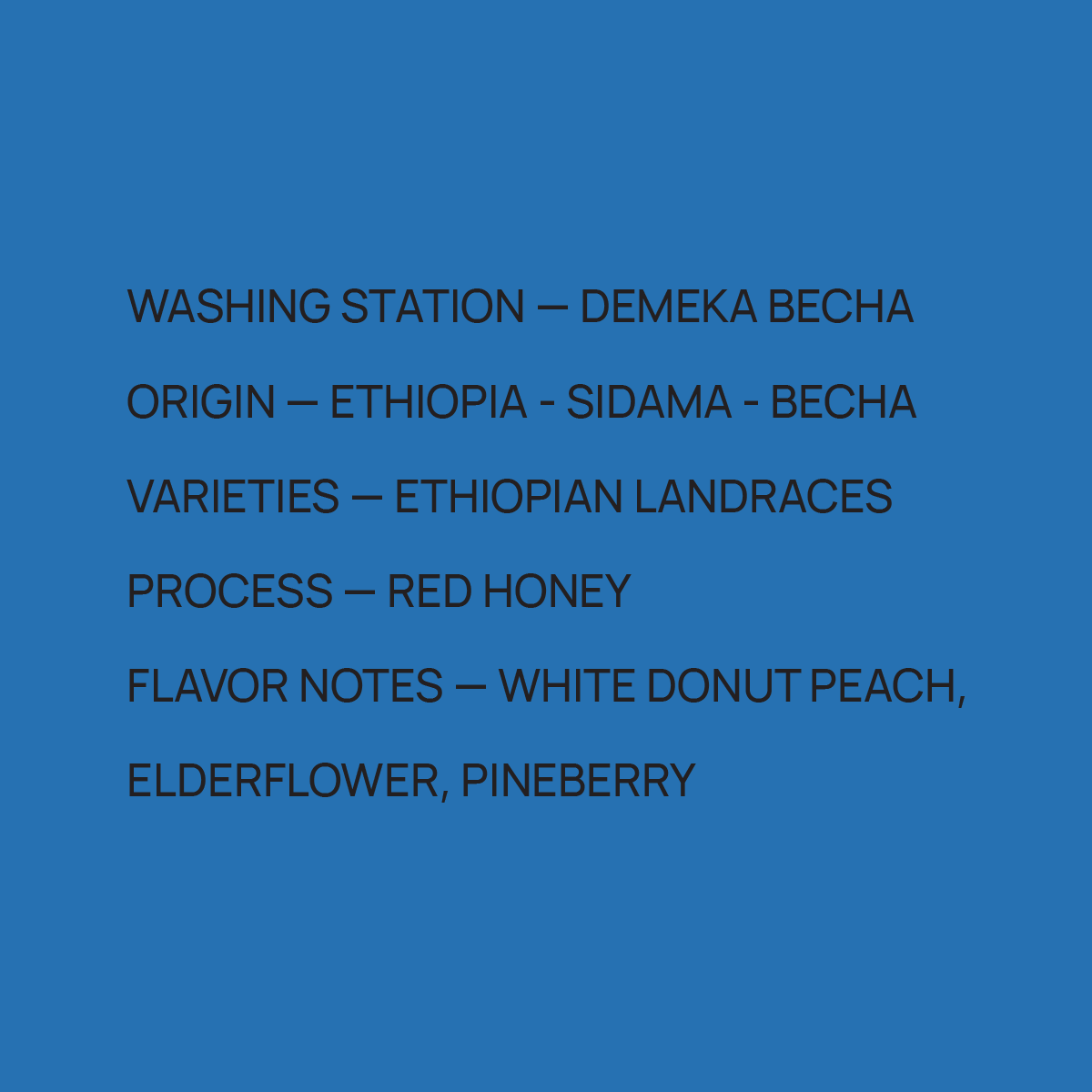
One of only a few Ethiopian coffees that we tracked down this season that not only hit, but fairly bludgeoned the mark (in the best way), is this lovely red honey lot from Demeka Becha washing station in the Sidama region. Sidama has become, without a doubt, our favorite region to source from in Ethiopia, primarily for the unbelievable degree of clarity and floral notes that we find in the best lots produced there, and this coffee in particular presents those characteristics in abundance. We're getting crisp white donut peach, fine, white elderflower, and sweet, perfumed pineberry, when enjoying this one.
Demeka Becha station is owned by Ayele Tulu, and managed by his son Tsegab Ayele, alongside Ayele's wife and Tsegab's mother, Genet Haile Endeshow. Set on a hilltop for ideal airflow over its drying beds, the site buys cherries from nearly 10,000 producers in surrounding communities, including Dilla Suke, Demeka, Goacho, Becha, and Bashiro Dale. Cherries are weighed, floated, de-pulped, and then fermented and washed in 12 tanks, with lower-density lots going to the Community Lot program or the local market. The parchment is hand-carried to the beds, spread to a depth of one fingertip, and turned until dry.
Ethiopian landrace or heirloom refers to any variety that is native to Ethiopia. Due to the coffee plant having originated in Ethiopia, and the long duration of its organic evolution and differentiation there, there is far more biodiversity in the genetics of Ethiopian coffee than in the coffee of any other producing country. This rich genetic heritage allows for a very high degree of quality and profile distinction in Ethiopian coffees, resulting in unparalleled complexity and sweetness. Additionally, due to this diversity and a general lack of research into the genetics of Ethiopian landraces, although a few varieties have been identified and named, most remain unnamed. The genetic landscape is so rich that it is often said that every town within the coffee growing regions of Ethiopia has its own distinct variety.
All coffee is sold whole-bean to reduce oxidation, and increase the longevity of volatile organic compounds.