Guatemala Luis Valdez
Guatemala Luis Valdez
Couldn't load pickup availability
Ships directly from Mirra Coffee, roasted to order every Wednesday and shipped Thursday (order by Tuesday night NYC time for that week’s roast). US delivery is typically 2–6 business days. Orders with coffees from more than one roaster arrive as separate boxes. Shipping & freshness →
?
Tasting Notes
Specific flavors and aromas the roaster (or our team) noticed when cupping this coffee. They describe the brewed cup, not flavorings added to the beans.
Read more in the glossary →-
Roast Level
?
Roast Level
How dark the beans are roasted, on a 'specialty' scale where Light/Ultralight preserves the most origin character.
Read more in the glossary → - Specialty Light/Ultralight
-
Flavor Profile
?
Flavor Profile
High-level flavor families this coffee leans toward — fruity, floral, sweet, chocolate/nutty, spicy, tea/botanical, or fermented/wine-like.
Read more in the glossary → - Fruity, Sweet
-
Origin Type
?
Coffee Type
Whether a coffee is a single origin (from one farm, region, or country) or a blend (multiple origins combined).
Read more in the glossary → - Single Origin
-
Flavor Notes
?
Flavor Notes (SCA)
More specific flavor families inside the broader profile, using the SCA Coffee Taster's Flavor Wheel — e.g. 'Citrus' and 'Berry' inside 'Fruity'.
Read more in the glossary → - Other Fruit, Caramel
-
Caffeine
?
Caffeine
Whether this coffee is caffeinated or decaffeinated, and (for decaf) which process was used.
Read more in the glossary → - Caffeinated
-
Country of Origin
?
Country of Origin
Where in the world this coffee was grown, or 'Multiple' for a blend with beans from more than one country.
Read more in the glossary → - Guatemala
-
Process Type
?
Processing
How the coffee cherry was prepared after picking — dried with or without its fruit, fermented under specific conditions, etc. Big effect on the final cup.
Read more in the glossary → - Washed
Cost per 250mL serving - $1.25
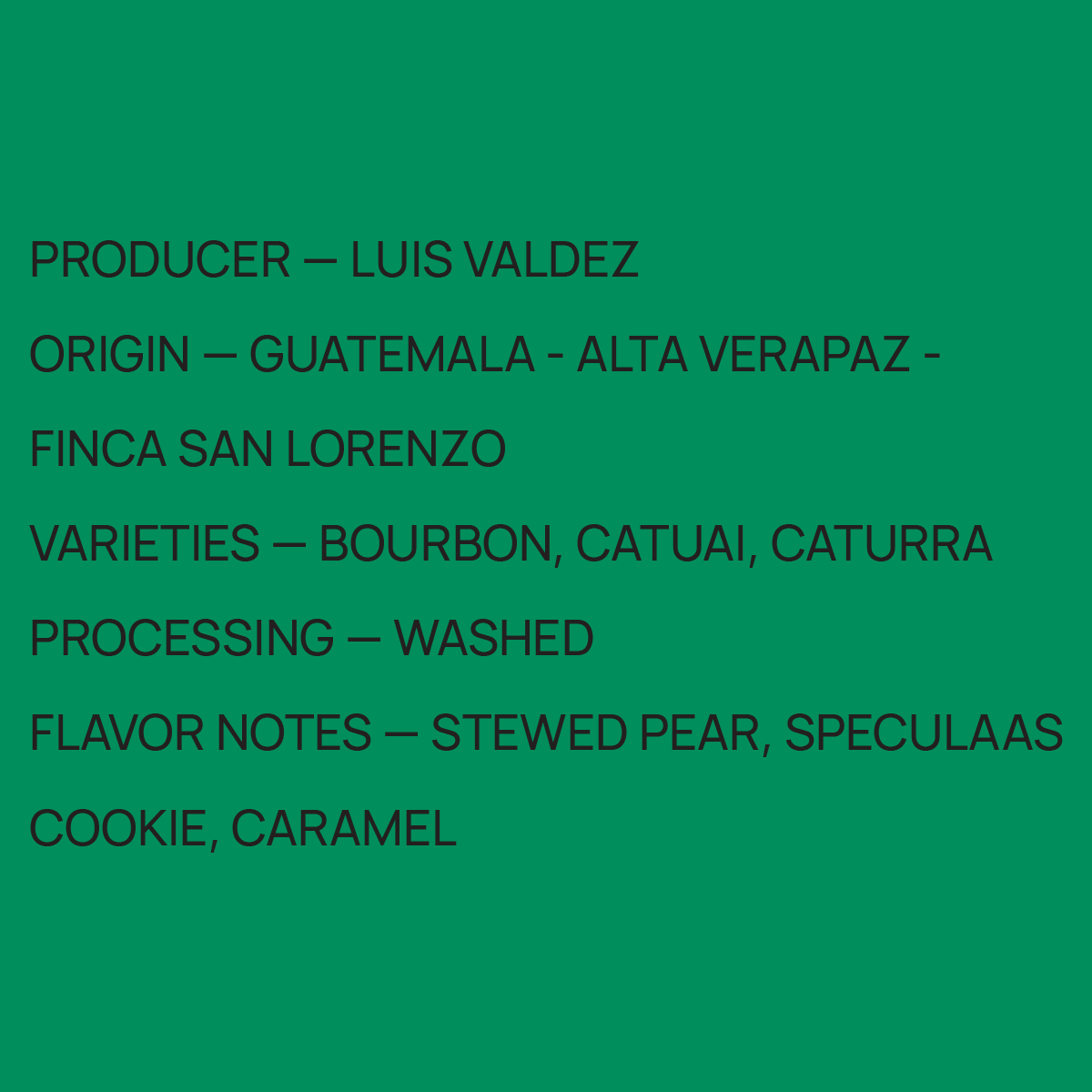
We’re ringing in the arrival of the next lot to feature in our lineup of white coffees, this one coming from Luis Valdes of Finca San Lorenzo in Guatemala. As always with our white coffees, this one has been specially selected and roasted to stand up nicely to milk, yet be nonetheless pleasant when enjoyed black. This one presents a classic sweet, mild, and round Guatemalan profile of stewed pears, speculaas cookie, and caramel — delish.
Luis Valdez represents the third generation of coffee producers in his family, and has two farms, Santa Isabel and San Lorenzo, the latter being the origin of this lot. Finca San Lorenzo is located at 1500 masl in Guatemala’s Alta Verapaz region—a region characterized by its year-round rainfall. On his farms, which total over 70 hectares of land, Luis grows caturra, catuaí, bourbon, sachimore, obata, and tupí among other experimental varieties. During his time in university, studying agricultural engineering, Mr. Valdez made frequent visits to Los Volcanes cooperative to learn as much as possible about the agriculture of coffee, more specifically. Since graduating in 1999, he has been cultivating specialty-grade coffee on his farms, with an eye toward constant annual improvement—a value we share and love to hear in the producers we source from.
Bourbon is one of the most ubiquitous and well-known varieties of C. arabica, particularly in South America. It is characterized by its high quality potential at altitude, plant height, lower production yield, and susceptibility to major coffee diseases. Bourbon was first introduced to Bourbon Island—now La Réunion—from Yemen by French missionaries in the early 18th century. It wasn’t until the mid 19th century that Bourbon proliferated beyond Bourbon Island, when it was brought by missionaries to Africa and the Americas. Bourbon was first planted in Brazil in the 1860’s, after which it spread rapidly north and west into other regions of South and Central America, where it remains common and popular today.
Catuai is the result of cross-breeding mundo novo and caturra, and was initially created in 1949 by the Agronomic Institute of Sao Paulo, Brazil, and released for cultivation in 1972. It is a smaller plant, being much more compact than caturra, which allows farms to plant them at a higher density, increasing overall yield and productivity. One of its primary drawbacks is its high susceptibility to leaf rust. Catuai can be found growing in both yellow- and red-fruited types. It remains a primarily Brazilian variety, with the exception of Guatemala, where it makes up around 20% of their total production.
Caturra is a natural mutation of the bourbon variety, and was first discovered in the Minas Gerais region of Brazil between 1915 and 1918. It is common throughout South and Central America, and is known for its flavor quality at altitude.
All coffee is sold whole-bean to reduce oxidation, and increase the longevity of volatile organic compounds.