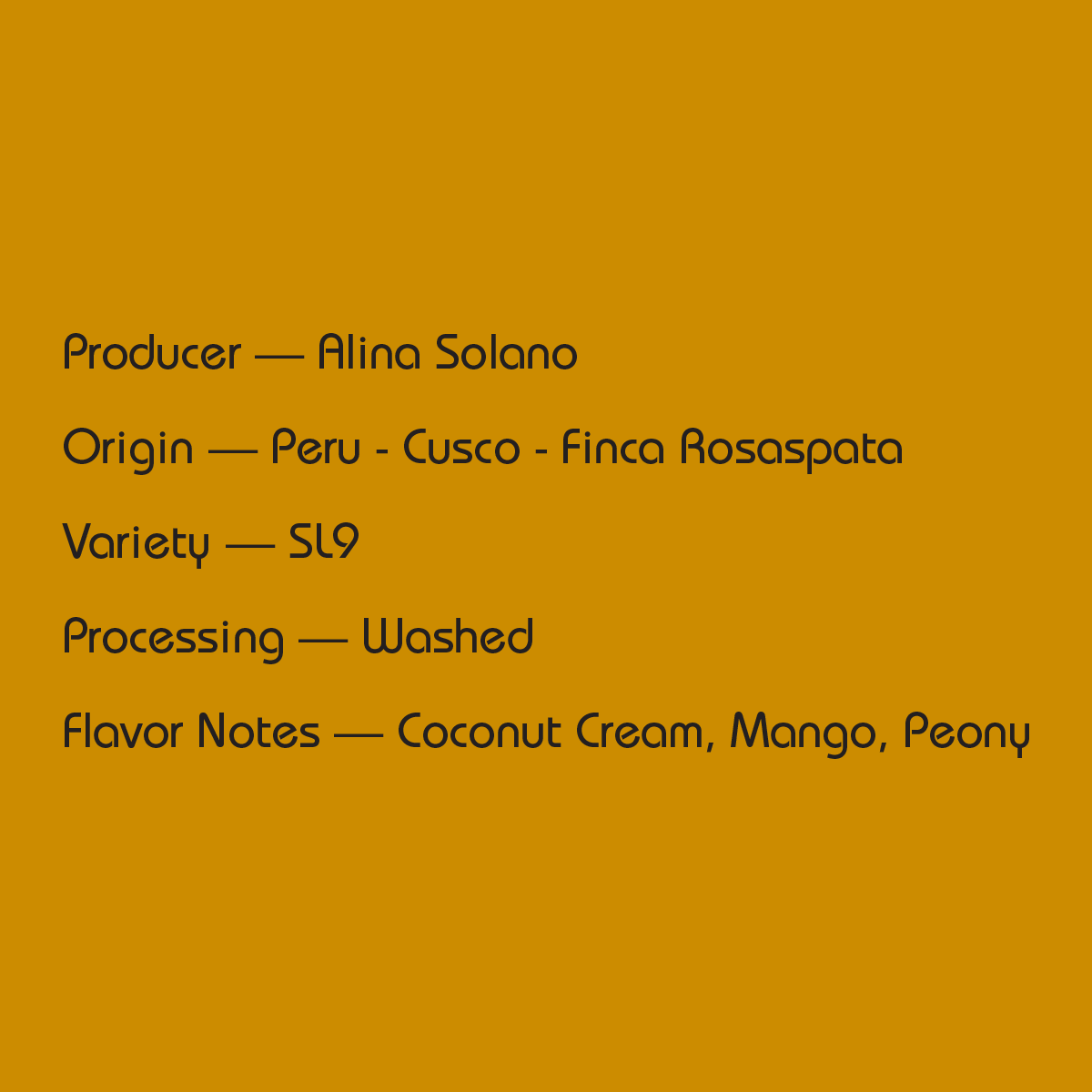
Peru Alina Solano
Peru Alina Solano
Couldn't load pickup availability
Ships directly from Mirra Coffee, roasted to order every Wednesday and shipped Thursday (order by Tuesday night NYC time for that week’s roast). US delivery is typically 2–6 business days. Orders with coffees from more than one roaster arrive as separate boxes. Shipping & freshness →
?
Tasting Notes
Specific flavors and aromas the roaster (or our team) noticed when cupping this coffee. They describe the brewed cup, not flavorings added to the beans.
Read more in the glossary →-
Roast Level
?
Roast Level
How dark the beans are roasted, on a 'specialty' scale where Light/Ultralight preserves the most origin character.
Read more in the glossary → - Specialty Light/Ultralight
-
Flavor Profile
?
Flavor Profile
High-level flavor families this coffee leans toward — fruity, floral, sweet, chocolate/nutty, spicy, tea/botanical, or fermented/wine-like.
Read more in the glossary → - Fruity, Floral
-
Origin Type
?
Coffee Type
Whether a coffee is a single origin (from one farm, region, or country) or a blend (multiple origins combined).
Read more in the glossary → - Single Origin
-
Flavor Notes
?
Flavor Notes (SCA)
More specific flavor families inside the broader profile, using the SCA Coffee Taster's Flavor Wheel — e.g. 'Citrus' and 'Berry' inside 'Fruity'.
Read more in the glossary → - Tropical, Floral
-
Caffeine
?
Caffeine
Whether this coffee is caffeinated or decaffeinated, and (for decaf) which process was used.
Read more in the glossary → - Caffeinated
-
Country of Origin
?
Country of Origin
Where in the world this coffee was grown, or 'Multiple' for a blend with beans from more than one country.
Read more in the glossary → - Peru
-
Process Type
?
Processing
How the coffee cherry was prepared after picking — dried with or without its fruit, fermented under specific conditions, etc. Big effect on the final cup.
Read more in the glossary → - Washed
Cost per 250mL serving - $2.62
A Peruvian SL9—finally! We’ve been hard at work tracking down what remains a rather elusive variety, SL9, from Peru and at long last hit a stroke of good luck in uncovering this stunning washed lot from Alina Solano of Finca Rosaspata, Cusco. All of the best coffees we’ve had from Peru over the last couple of years have been SL9 lots, so for us this lot represents the first of what are sure to be many outstanding Peruvian SL9s in Mirra’s future, so strap in and stay tuned. When brewed up, we get an abundance of rich, whipped coconut cream, perfectly ripe, seasonal Ataulfo mango, and subtle, delicate pink peony florals; given the flavor profile of this coffee, it’s no wonder that SL9 is often referred to as inca geisha.
Alina’s farm, Finca Rosaspata, is located at the unusually high altitude of 2.400 masl in the highlands of Cusco, Peru, and consists of only 2 hectares of cultivated farmland. The farm is isolated from any accessible roads by a rapidly flowing river, from which they use water for all of their cultivation and processing. The only connection between the farm and the road is a perilous bridge, which gets washed away every rainy season, and must be rebuilt regularly. Because the farm essentially becomes an island at time, depending on the state of the bridge and how it has been affected by weather, the connection with, dependence on, and, at times, resistance against nature is made all the more clear to the Solano family, as is their status as guardians of the land they cultivate and live on.
SL9, also often called inca geisha, is a variety whose origins remain shrouded by a veil of mystery, chiefly because the story told by its genetics, and the story told by the historical documentation on the cultivation and proliferation of SL9, offer two conflicting accounts of how this Kenyan variety wound up exclusively in Peru. Like SL28 and SL34, SL9 is also a single-tree selection made by Scott Laboratories in Kenya, some time between 1935 and 1939. In The Lost Origins of Inca Geisha—the most definitive and accessible source as of yet on SL9—Christopher Feran writes, “as far as any historical evidence shows, SL-09 was never—unlike SL-34 and SL-28—commercially grown outside of Kenya (I did find evidence of a variety trial in Malawi where SL-09 was planted alongside its more-famous peers),” (christopherferan.com). This is precisely where it gets interesting. Based on genetic testing, we know that the SL9 trees planted in Peru are either the same or incredibly close in genetic composition to the original selection made in Kenya in the 1930’s. Based on extant historical records, however, there is absolutely no record not only of SL9 ever being commercially planted and cultivated at scale, or of it ever being planted anywhere besides Kenya, and Malawi for a very limited variety trial. How this Kenyan variety made its way to the highlands of Peru remains, at least historically speaking, a total mystery. What matters most, however, is the flavor of SL9, which has the potential for extreme quality and complexity, with the best lots expressing an abundance of tropical fruits, sweetness, bold florals, and vibrant acidity.
All coffee is sold whole-bean to reduce oxidation, and increase the longevity of volatile organic compounds.