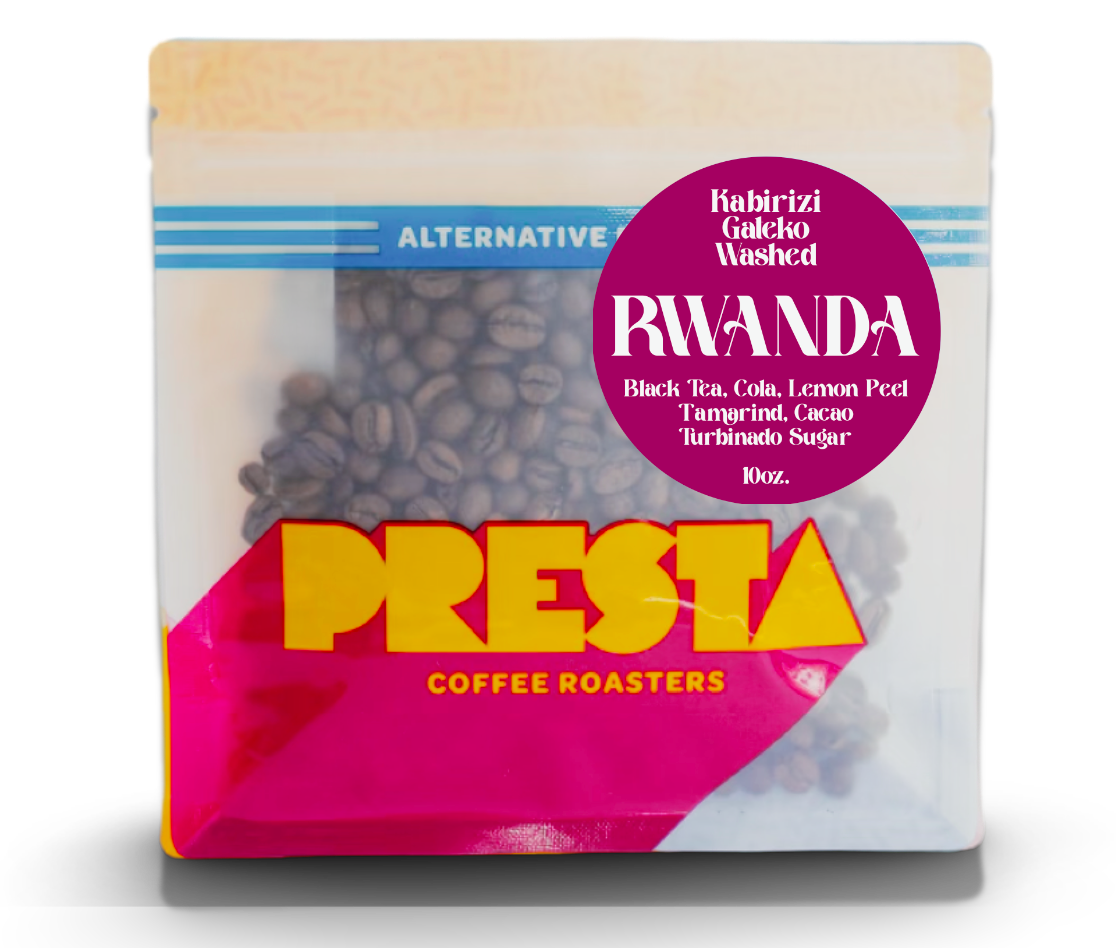
Rwanda - Kabirizi - Gateko
Rwanda - Kabirizi - Gateko
Couldn't load pickup availability
Ships directly from Presta Coffee, roasted to order and usually shipped within 48 hours (Mon–Fri). US delivery is typically 2–6 business days. Orders with coffees from more than one roaster arrive as separate boxes. Shipping & freshness →
?
Tasting Notes
Specific flavors and aromas the roaster (or our team) noticed when cupping this coffee. They describe the brewed cup, not flavorings added to the beans.
Read more in the glossary →-
Roast Level
?
Roast Level
How dark the beans are roasted, on a 'specialty' scale where Light/Ultralight preserves the most origin character.
Read more in the glossary → - Specialty Light/Ultralight
-
Flavor Profile
?
Flavor Profile
High-level flavor families this coffee leans toward — fruity, floral, sweet, chocolate/nutty, spicy, tea/botanical, or fermented/wine-like.
Read more in the glossary → - Tea/Botanical, Fruity, Chocolate/Nutty
-
Origin Type
?
Coffee Type
Whether a coffee is a single origin (from one farm, region, or country) or a blend (multiple origins combined).
Read more in the glossary → - Single Origin
-
Flavor Notes
?
Flavor Notes (SCA)
More specific flavor families inside the broader profile, using the SCA Coffee Taster's Flavor Wheel — e.g. 'Citrus' and 'Berry' inside 'Fruity'.
Read more in the glossary → - Tea, Citrus, Tropical, Cocoa
-
Caffeine
?
Caffeine
Whether this coffee is caffeinated or decaffeinated, and (for decaf) which process was used.
Read more in the glossary → - Caffeinated
-
Country of Origin
?
Country of Origin
Where in the world this coffee was grown, or 'Multiple' for a blend with beans from more than one country.
Read more in the glossary → - Rwanda
-
Process Type
?
Processing
How the coffee cherry was prepared after picking — dried with or without its fruit, fermented under specific conditions, etc. Big effect on the final cup.
Read more in the glossary → - Washed
Rwanda - Kabirizi - Gateko
Washing Station: KabiriziVariety: BourbonProcess: WashedElevation: 1,750 maslRegion: Rutsiro District
KabiriziKabirizi washing station was established in 2004 and has placed in the Cup of Excellence competition. The surrounding communities of Gateko, Rwinyoni, and Nganzo contribute coffees to the Kabirizi washing station. It is run by Coopérative pour la Promotion des Activités Café or COOPAC.COOPAC is a Fair Trade–certified cooperative located near Lake Kivu on the steep slopes of volcanic mountains. The organization was founded by Emmanuel Rwakagara, who is the president of COOPAC as well as the owner of the Gishamwana Island coffee estate. COOPAC began with 110 farmers in April 2001 and currently has 8,000 members contributing coffee from Ack, Ubuzima, Tuzamurane, Kopabm, Abakundakurima, and Abanyamurava. With 6 washing stations along the northern landscape of Lake Kivu, COOPAC exports 150 containers of Fair Trade-certified coffee annually.COOPAC is committed to environmental and social sustainability in addition to producing high-quality coffee. Waste by-products from processing are used as fertilizer rather than discarded into the lake, and shade trees are distributed to farmers to prevent soil erosion. COOPAC has assisted in the construction of a school, healthcare clinics, and roads and bridges in the community. The cooperative also has a program to distribute cows and goats to the most productive farmers and provides farmers with an agricultural advisor to teach the latest production methods.Washed Process (Rwanda Specific)The Washed process in Rwanda includes a unique soaking step, not unlike that often found in Kenya. The cherries are delivered to central processing units the day they are harvested, where they will be depulped and fermented in open-air tanks made of concrete or cement for 12–18 hours. After fermentation, the coffees are soaked in water for 24 hours, after which their mucilage will be removed and spread on raised beds to dry.RwandaLike most African coffee-producing countries (with the exception of Ethiopia), Rwanda was planted in coffee by colonial interests from Europe in order to supply the booming market back on their home continent. High-yield, low-cost varieties were introduced in the 1930s and made compulsory to farmers by Belgian colonials, offering little in the way of quality incentive or development. Coffee was intended to be a cheap commodity available in abundance, and the colonial government held strict mandates over exports in addition to imposing very high taxes on growers, practically enslaving them to the industry. Roughly 75 percent of the land mass of Rwanda is used for agriculture, and more than 35 percent of its population are subsistence farmers, many of whom rely on coffee for at least a portion of their income.While coffee became the staple agricultural export by the 1990s (despite very low market prices), its production, along with the national economy in general, was devastated by the genocide in 1994. Nearly 1 million people were killed in the national tragedy, which stalled development and slowed progress for nearly a decade. Targeted programs initiated by the government in the early 2000s encouraged Rwandans to use specialty coffee as one of the means to recover and create a new niche agricultural market. The erection of the first washing station with USAID support in 2004, and the country was the first to host a Cup of Excellence auction, bringing international recognition to the “Land of a Thousand Hills” as a potential producer of exceptional quality.
Today, this tiny country (roughly the size of Maryland) contributes less than 0.2 percent of the global coffee supply, but its reputation for special quality and unique characteristics—not to mention the incredible story of its development as a specialty-coffee origin since the genocide—have earned Rwanda a significant place at the table among African origins.